
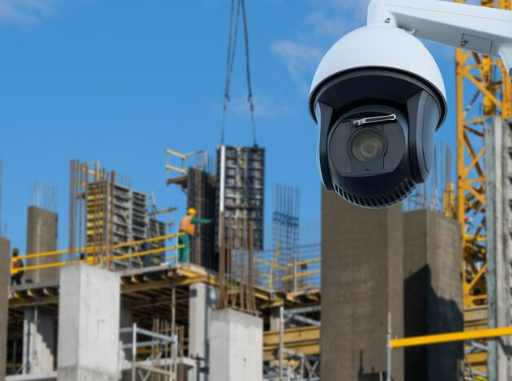
Most site security setups in Dubai are nothing more than expensive theater. You hire a local guard company, string up a few cheap domestic lenses around the perimeter fencing, and check a compliance box for your insurance provider. Then, a shipment of specialized copper cabling vanishes at 3:00 AM from a blind spot in your staging area, and your morning is entirely ruined.
The blunt truth of managing a multi-million-dirham footprint in 2026 is that traditional security methods cannot scale with the speed of Dubai’s vertical builds. A perimeter wall changes its geometry every single week as columns are poured and scaffolding ascends. If you are still relying on static, unmanaged security infrastructure, you are leaving your material assets, your timeline, and your legal liability completely exposed to whoever walks past the gate.
The Blind Spots in Traditional Perimeter Security
The most common mistake project directors make is treating a dynamic jobsite like a static warehouse. They position a few fixed construction site security cameras on the main gate and the site office, then assume the entire interior footprint is safe. This approach ignores how quickly a live site creates its own physical blind spots.
As a tower grows or a residential community expands, newly poured concrete walls and stored material pallets completely block the line of sight of your initial setup. A perimeter camera that had a clear view of the yard in January is utterly useless by March because it is staring directly into the back of a newly erected substation.
A static security layout is obsolete the exact moment your team pours the first-floor slab.
To combat this, your construction site surveillance strategy must be fluid. Modern setups utilize rugged, solar-powered mobile tower units that can be repositioned via a forklift within twenty minutes. As your logistics layout shifts to accommodate incoming structural steel or MEP components, your visual perimeter can be altered right along with it.
Mitigating Shrinkage and Subcontractor Finger-Pointing
Material theft in the emirate rarely looks like masked intruders scaling a fence in the middle of the night. True asset loss is usually internal, incremental, and incredibly bureaucratic. It happens when a subcontractor overstates their material usage, or when a delivery vehicle leaves the site with a half-empty bed that should have been stripped of scrap metals.
A professional construction site surveillance network changes the dynamic of these interactions by creating an unbending visual ledger. When you have high-definition, thermal-enabled optics trained on your storage yards, you stop guessing where your raw inventory went.
| Surveillance Type | Operational Utility | Coverage Agility | Primary Risk Covered |
| Static Wired Cameras | Low (Fixed view) | Poor (Requires cabling) | Basic perimeter breach |
| Mobile Solar Towers | High (Analytical) | Excellent (Forklift ready) | Internal asset shrinkage |
| Aerial Site Audits | High (Macro overview) | Dynamic (On-demand) | Milestone verification |
Consider a recent scenario at a high-end commercial development near Dubai South. A concrete subcontractor claimed they had delivered forty truckloads of ready-mix during an extended weekend pour and demanded immediate milestone sign-off. The main contractor reviewed the remote construction site surveillance archive and counted exactly twenty-eight trucks entering the wash bay during those hours. The subcontractor had attempted to bill for material that was diverted to an entirely different project down the road. The visual proof settled a potential six-figure billing dispute in under ten minutes.
Thermal Analytics and Real-time Incident Prevention
Standard video recording works fine when the sun is out, but Dubai nights present a completely different set of operational challenges. Dust storms, low-lying coastal fog, and poorly lit excavation pits render standard night-vision sensors completely blind.
Upgrading your site security camera infrastructure to include thermal imaging sensors allows you to bypass environmental limitations entirely. Thermal hardware does not care about sandstorms or zero-visibility fog; it tracks heat signatures. If an unauthorized individual attempts to navigate through an unlit trench at the rear of your site, the system flags the thermal contrast instantly, alerting your remote monitoring team before the person even reaches your interior equipment storage.
This level of proactive alerting is where your investment shifts from an insurance write-off to an active cost-containment tool. Instead of reviewing grainy footage of a theft that happened three days ago, your system detects the intrusion in real time, allows for automated voice down-challenges via site loudspeakers, and dispatches authorities while the breach is actively occurring.
Balancing Active Surveillance with High-Definition Documentation
There is a major structural difference between a system built to catch a trespasser and one meant to document project velocity. To run a tight operation, you need a hybrid approach that integrates active Video Recording and CCTV Recording for asset protection with high-level analytical overviews.
While your mobile ground towers secure the perimeter and the tool cribs, your project management teams need a macro perspective of the site’s overall footprint to verify subcontractor progress to international investors. This is why forward-thinking developers are now pairing their ground-level construction site surveillance with monthly Drone Timelapse Services. The aerial perspective captures structural alignment, site cleanliness, and heavy machinery utilization rates from angles that a crane-mounted camera can never achieve.
Ground cameras protect your inventory; aerial tracking validates your entire master schedule.
This combined data approach allows you to run a highly efficient project. You can check your ground-level site security camera feeds to verify daily manpower compliance, while simultaneously using aerial mapping to confirm that your earthworks are progressing according to your digital twin models. It removes the reliance on subjective progress reports from subcontractors who have a vested interest in hiding delays.
Selecting Hardware That Survives the Jobsite Reality
The physical environment of a construction site is incredibly violent for electronics. It is not just about the ambient heat; it is about the constant high-frequency vibrations from pile drivers, the heavy dust kicked up by rock crushers, and the occasional voltage spike when a hybrid generator cycles on and off.
If you deploy residential-grade construction site security cameras onto a heavy infrastructure project, the internal optical stabilization mechanisms will fail from the vibration within weeks. Your hardware needs to be specified with industrial-grade vibration dampening, sealed metal housings, and robust electrical surge isolation.
Buying cheap cameras for a live site is simply financing your next equipment replacement cycle.
The operational cost of a blind site is always higher than the cost of proper hardware. If an accident occurs on your site and your system went offline because a basic power regulator failed under load, your legal exposure under UAE labor and insurance laws can be catastrophic. A hardened, continuously monitored system ensures that if a safety incident occurs, you possess the raw, unedited data required to prove your site met all local regulatory safety standards.
Frequently Asked Questions
Why can’t we just rely on human security guards to patrol the site perimeter?
Human guards have their limits. They get tired. They cannot see. They can only cover much ground. For example a guard cannot see through a sandstorm. They also cannot watch the four corners of a fifteen-acre site at the same time. On the hand a construction site surveillance system can keep an eye on the whole area all the time. It does not take breaks. A construction site surveillance system can cover the site without missing a thing. A construction site surveillance system provides monitoring. A construction site surveillance system keeps watch across the footprint of a construction site. A construction site surveillance system is always watching the construction site.
How do mobile solar surveillance towers communicate without on-site internet?
These special units have 5G modems that can work with many carriers, at once. They use cellular networks to send high-quality alerts and video data to a cloud dashboard. This way they work fully before the local phone and internet services are set up on the site.
What happens if someone cuts the power or tampers with a site security camera?
Professional surveillance systems have batteries inside them. These batteries keep the system running for up to 72 hours when there is no power.The system will send a ” alert” to the central monitoring station right away if something is wrong with a camera. This happens when a cameras view is blocked or if it is not pointing in the direction. It also happens if the camera is not connected. The central monitoring station gets this alert because the surveillance system is important. The surveillance system sends this alert because it is a priority. The surveillance system has these alerts, for the cameras.
Can these surveillance systems help us monitor safety compliance on site?
Yes modern systems can be set up to use AI analytics. This helps check if workers are wearing safety gear, like high-visibility vests and hardhats. The system can flag if workers are not following safety rules. This way safety officers can fix the problem before something bad happens. They can make sure workers wear gear. Modern systems make it easier to follow safety rules.
Are drone services legal for site documentation under local regulations?
Yes that’s okay if a licensed operator with approvals from the Dubai Civil Aviation Authority and security bodies does the operations. Using data with your construction site cameras on the ground gives a clear record of how the site is progressing and how well logistics are working. This way you can see site progress and logistical efficiency clearly. The aerial data and ground-level construction site surveillance together provide a picture. So integrating data, with ground-level construction site surveillance is helpful.
The decision to install an advanced monitoring framework is not about buying more cameras; it is about establishing complete operational control over your project. Relying on outdated security theater leaves your business exposed to material loss, fraudulent billing, and severe scheduling delays. Implementing a robust, analytical construction site surveillance solution guarantees that your assets remain secure, your team remains accountable, and your project finishes exactly on schedule.