
There’s a moment every project manager in this city knows. It’s a Sunday morning, you’re stuck on Sheikh Zayed Road, and your phone rings. Something happened on site over the weekend. Nobody’s quite sure what, or when, or who was there.
You’ll spend the next four hours finding out. Maybe longer.
That phone call is the reason construction monitoring has quietly become standard practice on serious Dubai developments. Not because anyone loves cameras. Because the alternative is guesswork, and guesswork on a billion-dirham project gets expensive fast.
Dubai Builds Faster Than Most Places, and That’s the Problem
Look at the pace here. Towers going up in Business Bay, infrastructure work stretching out toward Dubai South, mixed-use developments in Expo City that changed shape three times during design. Programmes are aggressive. Contractors are running multiple packages at once, sometimes with a dozen subcontractors on site the same week.
Nobody can physically watch all of that. A site engineer covering four floors is missing what’s happening on the other twelve.
Proper construction monitoring closes that gap. It doesn’t replace your team, it just means the site keeps a record of itself while everyone gets on with their actual job.
What Actually Goes Wrong Without It
Ask around and the stories repeat.
Materials disappear over Eid weekend. A subcontractor claims access was blocked for nine days and nobody can prove otherwise. Somebody pours a slab before the MEP first fix is signed off, and by the time anyone notices, it’s under 200mm of concrete. An incident happens near the hoist and two witnesses remember it two different ways.
Every one of those is a dispute, a delay, a cost, or all three. And every one of them is solvable with footage.
Good construction site security monitoring means the site is never unattended, even when it’s empty. That’s most valuable exactly when you’d expect — nights, Fridays, the long public holidays when a compound sits quiet and someone decides to try the gate.
Security Is the Obvious Benefit. It Isn’t the Biggest One.
Most people come to us thinking about theft. Copper cable, generators, tools, diesel. Fair enough — construction site surveillance stops a lot of that, and insurers notice when you take it seriously. Some clients have seen their premiums move because of it.
But the developers who’ve been doing this a while will tell you the real return is elsewhere. It’s in the arguments that never happen.
When there’s a time-stamped visual record of the site, the extension of time claim gets resolved in a meeting instead of a legal process. The variation order conversation has evidence attached. The safety investigation has facts. That’s where construction monitoring quietly earns back its cost, several times over, on a single large project.
Remote Oversight for People Who Can’t Be There
Half the decision-makers on a Dubai development aren’t in Dubai.
Investors in London. A parent company in Riyadh. A design consultant who visits once a month. They all want to know how the job is going, and none of them are going to stand in 46-degree heat to find out.
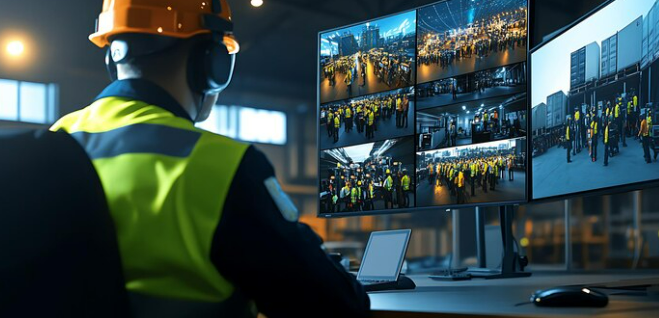
A Live Video Monitoring Dubai setup solves that in the simplest way possible. They open a browser, they see the site as it is right now, they get on with their day. No calls, no chasing the PM for photos, no eight-page progress report that’s already three weeks out of date by the time it’s circulated.
We’ve had clients tell us the volume of “what’s the status” emails dropped noticeably within a month of going live. That alone bought back a serious chunk of someone’s week.
It Keeps You Straight with Authorities
Dubai Municipality, the developer’s consultant, the health and safety officer — they all want documentation, and they want it consistent.
Continuous construction monitoring gives you an archive rather than a scramble. When someone asks for evidence that scaffolding was compliant on a given date, or that a hoarding was properly in place, you don’t send a runner to look through WhatsApp groups. You pull the date and you send the frame.
For projects that run under strict HSE regimes — and most of the big ones do — that archive is worth having before anyone asks for it.
Better Coordination Between Trades
Here’s an underrated one.
Weekly coordination meetings tend to go in circles because three people describe the same bottleneck three different ways. Put the footage up on the screen and the discussion changes. Everyone’s looking at the same thing. The meeting gets shorter and more useful.
Sites running construction monitoring properly tend to catch sequencing problems earlier, simply because someone in the office spots them while reviewing the day’s images instead of finding out at the end of the week.
The Setup Has to Survive Dubai
This is where a lot of cheap installations fall over. Literally, sometimes.
Standard housings don’t cope with 48 degrees. A March sandstorm will get into anything that isn’t sealed properly. Sites in early stages have no mains power and patchy network, so anything that assumes a nice clean cable run is useless.
Our equipment is built locally, for exactly these conditions — solar with battery backup, 4G uplink, sealed weatherproof enclosures. Cameras are placed after a walk of the site, not guessed at from a drawing, because the building will rise into the frame and you want the sightlines right from day one.
Alongside that, our Video Recording and CCTV Recording setup stores everything twice, locally and in the cloud. A client once needed footage from three months back for an insurance matter. It took about five minutes to find.
What a Typical Deployment Involves
Nothing complicated, honestly.
We come out and look at the site — usually an hour. We work out camera positions, talk through what you need to see, and recommend a mix. Most large developments end up with a combination: fixed cameras for progress documentation, plus dedicated construction site security monitoring points covering gates, stores, and the compound perimeter.
Installation is normally a day or two. Then it runs on its own. You get a login, images and feeds upload automatically, and nobody on your team has to remember to do anything.
A Few Common Questions
Does this replace security guards? No. It makes them far more effective. Construction site surveillance catches what a patrol misses between rounds, and gives your guard a reason to be somewhere before an incident, not after.
Can we scale it up as the project grows? Yes. Most sites start with a few units and add coverage as the footprint expands.
How long is footage kept? As long as you need. Cloud storage means you’re not deleting last quarter to make room for this one.
Get Ahead of the Next Phone Call
If you’re running or planning a major development in the UAE, the honest advice is to get construction monitoring in place before you break ground. It’s cheaper, the coverage is cleaner, and you’ll have the record from day one instead of from whenever someone finally decided it mattered.