
Ask any site engineer in Dubai what slows down progress documentation and you’ll usually hear the same answer: power. Running a cable across an active site is a headache nobody wants. Trenching costs money, the line gets cut by an excavator in week three, and the whole setup moves again once the structure goes vertical.
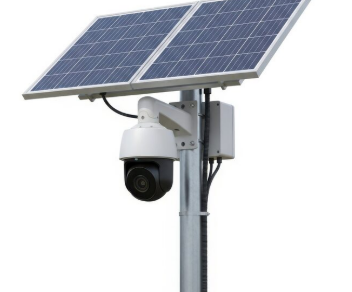
That’s the reason a solar powered timelapse camera has become standard kit on most large builds here. It runs on its own. No mains connection, no generator, no daily trips up a scaffold to swap batteries. You bolt it to a pole, point it at the building, and it keeps shooting for months.
Here’s what’s actually going on inside one of these units.
The power side of things
Every solar timelapse camera setup has four parts working together: a solar panel, a rechargeable battery, a charge controller, and the camera itself.
The panel collects sunlight during the day and feeds it into the battery through the controller. The controller is the bit people forget about, but it matters. It stops the battery from overcharging when the sun is blazing, and it stops it from draining flat during a cloudy stretch. Without it, you’d be replacing batteries every few months.
Dubai gives you roughly 9 to 10 hours of usable daylight most of the year, which is far more than these systems need. A properly sized panel can top up a battery in a few hours. The rest of the day is surplus. That surplus is what keeps the camera running through the night and through the odd sandstorm week when the panel is half covered in dust.
Most units are built to survive several days with no sun at all. In this region you rarely need that buffer, but it’s good to have.
How the camera actually captures
A construction camera doesn’t record video the way a CCTV unit does. That would fill storage in days and burn through the battery by lunchtime.
Instead it sleeps. The camera powers down between shots and wakes up only when it’s time to take an image. On a typical build, that’s one photo every 10 or 15 minutes during working hours. Some clients want a shot every 5 minutes for a busy concrete pour week, then back to a slower interval once the structure tops out.
That sleep cycle is the whole trick. A solar powered timelapse camera draws almost nothing for 99% of the day. It only pulls real current for the second or two it takes to fire the shutter and push the file out.
Once the image is captured, it goes two places. It’s written to a local card inside the housing, and it’s uploaded over 4G to the cloud. You get the redundancy of a physical copy on site plus the convenience of viewing from anywhere. If the SIM drops out for a day, nothing is lost. The unit catches up on the backlog once signal returns.
Stack 20,000 of those images together at the end of a project and you have a two-minute film showing eighteen months of work.
Built for the weather here
This is where a proper outdoor timelapse camera separates itself from a hobby setup in a plastic box.
Summer surface temperatures on an exposed pole in Abu Dhabi can push well past what consumer electronics are rated for. Sand gets into everything. Humidity near the coast causes condensation inside cheap housings, and a foggy lens ruins a month of footage before anyone notices.
So the housings are sealed, usually IP66 or better, with a hardened glass front and internal ventilation designed to handle heat without letting dust in. Cabling is UV rated, because ordinary PVC goes brittle and cracks after one summer. Mounting brackets are stainless or galvanised, since anything else starts rusting within a season on a coastal site.
We build our own units locally for exactly this reason. Off-the-shelf imports kept failing in July, and a camera that dies in July is a camera that misses the most productive months of the year.
Where you put it matters more than the spec sheet
The best solar powered timelapse camera in the world gives you nothing if it’s pointed at a tower crane that eventually blocks the building.
Site survey comes first. We walk the plot, check where the structure will be at full height, and work out which direction the sun travels across the facade. South-facing shots in this part of the world can blow out badly at midday, so the angle gets adjusted for that. We also look at what’s going to be built next door, because a neighbouring plot going vertical in month six can kill a perfectly good sightline.
The panel needs its own thought. It should face the sun without the camera arm casting a shadow across it, and it needs to sit at an angle steep enough that dust slides off rather than settling. A flat panel in Dubai is a dirty panel within a fortnight.
Height is the last call. Too low and site hoarding blocks the base of the building. Too high and you need a cherry picker every time something needs checking. Most of our installs sit on an existing structure, a light pole, or a dedicated mast at the boundary.
Maintenance is lighter than people expect
A well installed outdoor timelapse camera needs a visit maybe once a quarter. The panel gets wiped, the housing glass gets cleaned, connections get checked, and that’s usually it.
You’ll know before we do if something’s wrong, because the online platform shows you the latest image. If the frames stop arriving or the view looks obstructed, that’s the trigger for a site visit. We monitor upload activity on our side too, so in most cases we’re calling you rather than the other way round.
Battery health is the one component with a real lifespan. Depending on the chemistry and how hard it’s cycled, expect several years of service. On a two-year project you won’t touch it.
Where it fits alongside everything else on site
A construction camera and a security system solve different problems, and it’s worth being clear about that. Timelapse gives you a progress record, marketing footage, and a dated visual archive you can pull up during a claim. It’s not surveillance.
If you need live coverage of gates, material stores and access routes, that’s a separate job, and our Video Recording and CCTV Recording package handles it. Plenty of clients run both from the same site, and both feed into the same login.
For the documentation side on its own, our Construction Time Lapse Service covers survey, install, hosting and the final edit at handover.
Getting one on your site
If you’re planning a build that runs longer than a few months, a solar timelapse camera is one of the cheaper decisions you’ll make and one of the few that keeps paying off after the project closes. Developers use the final film in sales suites. Contractors use it to win the next tender. Project managers use the daily frames to settle arguments about when something actually happened.
We’ll come out, look at the plot, and tell you honestly how many positions you need. Some sites need one. A large mixed-use development might need four.