
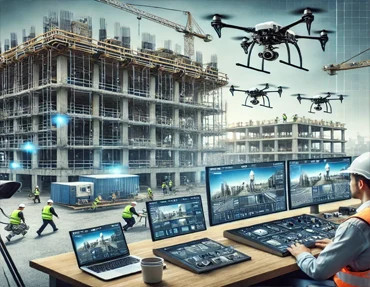
Everyone asks about the cameras first. What resolution, will it survive a Dubai July, where exactly does it get mounted. Fair questions, all of them. But the one that really decides whether your finished video is worth showing anybody is much plainer: how long do you leave it running?
We’ve had contractors ring us in month fourteen of an eighteen month build. We can still help them. What we can’t do is go back and film the excavation that wrapped up last spring. Duration is the one variable nobody can fix later, which is why the length of a construction timelapse project deserves more thought than the camera spec sheet ever gets.
Start before the ground opens, finish after the hoarding comes down
The short answer: a construction timelapse project should begin before the first excavator rolls in and end once the site fencing is gone.
Sounds obvious until you look at when people actually call. Usually after mobilisation, sometimes after the raft is already poured. And that empty plot is the whole reason the video works. Without a proper “before”, your “after” is just a photo of a building. Bare land, site setup, the first machines arriving through the gate. That’s the part people lean forward for.
Same story at the other end. Plenty of teams switch off the moment the structure tops out, then ask six weeks later whether we can add the façade and the landscaping. Camera’s already down by then.
Rough run times by build type
None of this is a rule, but after a few hundred sites across the UAE the pattern holds up:
- Villas and small residential: 6 to 12 months
- Mid-rise commercial, G+8 to G+15: 12 to 20 months
- Towers and mixed-use developments: 24 to 36 months, sometimes longer
- Infrastructure, roads and utilities: 18 months to several years, usually phased
- Fit-out and refurbishment work: 3 to 8 months
Anything past the two-year mark puts you into long term timelapse territory, and that’s a genuinely different animal from a six month villa job.
What changes on a long run
On a short build you install, you check in occasionally, you collect. On a long one, the site changes around your equipment.
Cranes get relocated. That perfect angle from the north boundary becomes a view of a stair core. Tower cranes come down in month twenty and your mounting point disappears with them. Site power shifts. Hoarding moves as the plot boundary tightens up.
Planning a construction timelapse project of this length means assuming all of that will happen and building relocation in from day one. We usually run a second unit on the long jobs for exactly this reason, so timelapse recording never has a gap while a camera gets moved across the site.
Lens cleaning matters far more too. Three months of dust on a housing window will quietly ruin a year of otherwise perfect frames.
Ending early costs you the story
The most common regret we hear has nothing to do with image quality. It’s stopping too soon.
A construction time lapse that ends at structural completion shows steel and concrete. Impressive enough, but incomplete. Cladding going up, glass catching the sky, landscaping arriving, exterior lighting switching on for the first time. That’s the payoff, and it’s the section a construction project video genuinely needs if it’s heading into a sales suite or an investor deck.
Half your build looks like every other build in the emirate. The last fifteen percent is what makes it yours.
Running a little longer than you think
Worth considering the other direction as well. Programmes slip. That isn’t pessimism, it’s the industry.
Leaving cameras up an extra four to eight weeks past your target completion date costs very little and covers snagging, MEP commissioning, final cleaning and handover day. Some clients get their best footage inside that buffer. One handed over during a ribbon-cutting, and the crowd walking in on the final morning gave the construction project video an ending nobody had planned for.
Duration and interval are the same question
How long you run decides how often you shoot.
Quick maths. A 30 second final cut at 24 frames per second needs roughly 720 usable frames. Spread across an 18 month construction timelapse project, that’s technically one frame every 18 hours.
Nobody shoots like that. You capture dense and cut hard, because a frame every 18 hours will miss the day the core jumped a floor. On most sites we’re capturing every 10 to 15 minutes through working hours, then thinning it right down in the edit. On a three year job that’s millions of images, which is exactly why storage gets planned at the start instead of in month twenty when a drive fills up.
Interval also shifts by phase. Excavation and structure move fast and deserve tight capture. Fit-out looks slow from outside, so we often widen the gap there and save the density for elevations and external works. Consistent timelapse recording through the quiet months is what makes the busy months look dramatic.
Phased sites need phased thinking
Big masterplans rarely run as one continuous construction timelapse project. Plot one starts, plot four sits empty for a year, infrastructure carries on across the whole thing regardless.
For those we normally break the Construction Time Lapse Service into overlapping phases, with cameras added and retired as plots activate. You end up with one master film plus individual plot videos, which is far more useful than a single wide shot where nothing appears to happen for months at a stretch.
Long jobs usually need more than one camera type
Once you’re past a year on site, most clients want more than a highlight film at the end. They want to see the site today.
That’s where our Video Recording and CCTV Recording setup tends to come in alongside the timelapse units, so the same site is covered for security and daily oversight while the long term timelapse quietly builds in the background. Same poles, same power, one installation visit.
Questions worth answering before you commit
Get these sorted before signing anything:
- Your programme dates, honestly. Not the contract date. The realistic one.
- Where the cranes go, and when they leave. This drives every mounting decision.
- Power and connectivity. Solar and 4G work fine here, but they need planning.
- Who needs viewing access. Client, consultant, marketing team, head office abroad.
- What the video is actually for. A handover gift and a leasing campaign are different edits.
- Your buffer. Add the extra weeks now, not in a panic later.
A construction time lapse booked with those answers in hand almost always ends better than one arranged in a rush after mobilisation.
The Dubai variable
Local conditions genuinely affect how long you can run without someone climbing a pole.
Summer heat pushes electronics hard. Sandstorms coat everything overnight. The midday work ban shifts activity into early mornings and evenings for months, which changes when the interesting frames actually happen. Ramadan alters site hours too.
Getting a construction project video out of all that, uninterrupted, needs equipment built for the conditions and a team close enough to reach site quickly when something needs attention. Ours is based here, which is most of the reason our long runs stay unbroken.
So, how long?
For most builds: from site clearance to a month or two after handover. For towers and infrastructure: plan a long term timelapse with camera relocation, phased intervals and storage sorted from day one.
The best answer stays the simple one. Start earlier than feels necessary, finish later than you think you need, and you’ll never be the person asking whether we can somehow recover footage of a foundation poured eight months ago.
If you’ve got a programme in front of you and you’re working out where cameras should sit and how long the construction timelapse project should run, send it over. We’ll look at the dates, suggest a setup, and tell you honestly if a shorter run makes more sense for what you’re trying to achieve.